- +91 9100499947, 9849645600
- Hyderabad, India
- marketing@greenlanternit.com

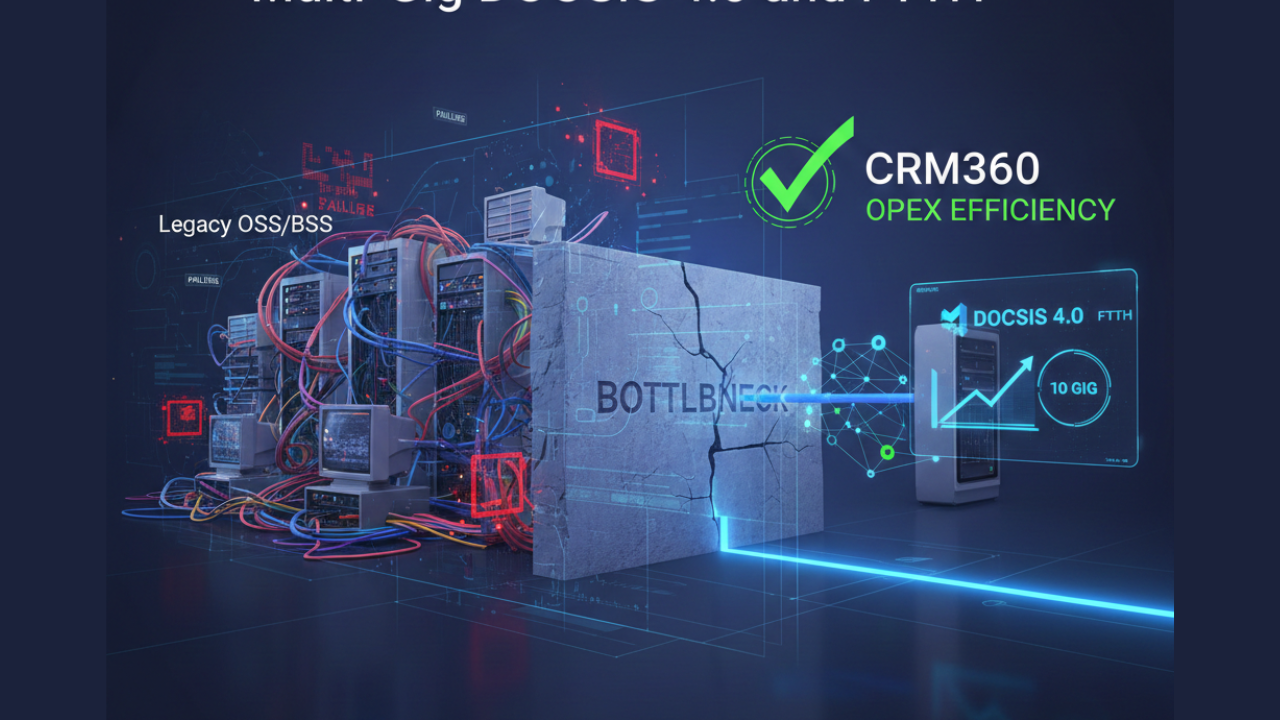
The American ISP landscape is undergoing its most aggressive upgrade cycle in decades, driving many providers to evaluate the best customer management software alongside network modernization efforts. Driven by competitive fiber builds and the push to DOCSIS 4.0, trillions are being spent on infrastructure (Capital Expenditure, or CAPEX) to deliver true Multi-Gig (multi-gigabit) access to consumers.
But here’s the main point: the success of these big rollouts won’t depend on network speed alone. It will also depend on how well the business operations (Operational Expenditure, or OPEX) work with the best CRM software and OSS/BSS platforms. The biggest risk to getting a return on this CAPEX is the old, broken, and inflexible ecosystem of Operational Support Systems (OSS) that most providers use to manage the network and Business Support Systems (BSS) that they use to handle customer and billing interactions.
These systems were designed for a slower, asymmetric world. They are now struggling to provision, assure, and bill for the complex, dynamic services of the future, effectively turning an engineering marvel into a commercial nightmare.
For decades, the HFC (Hybrid Fiber-Coaxial) model was defined by asymmetry: high downstream bandwidth, low upstream bandwidth. Legacy BSS/OSS stacks were hardwired to this reality, particularly in provisioning and billing. This limitation highlights why ISPs increasingly require the best customer management software to support symmetric, multi-gig services.
The current transformation focuses on two next-generation technologies: Fiber-to-the-Home (FTTH/PON) and Full Duplex DOCSIS 4.0. FTTH/PON delivers end-to-end fiber connectivity, while DOCSIS 4.0 enables symmetrical speeds over existing coax infrastructure. Together, they introduce a new reality of symmetrical, low-latency services. This shift breaks legacy systems in three critical ways.
The fragmented nature of legacy IT environments is the most significant operational drag. Typically, a single customer order touches five to seven separate systems before service is fully provisioned: CRM, Order Management, Service Inventory, Network Inventory, Provisioning, and Billing.
This is where a modern, integrated platform like CRM360 becomes essential. Designed as an API-first solution, CRM360 collapses disparate systems into a single, streamlined architecture. For US ISPs to truly monetize their multi-gig infrastructure, CRM360 delivers the necessary integrated capabilities:
The decision facing every major US ISP is whether to invest millions more in duct-taping their outdated systems or to make the strategic shift to an agile, cloud-native BSS/OSS architecture like CRM360.
CRM360 is not just an IT upgrade; it is the last essential step in realizing the full profit potential of the multi-gig investment. Built around API standards (like TM Forum Open APIs) and cloud principles, it future-proofs the operational side of the business.
Failing to modernize the support systems means that every new customer, every service upgrade, and every reported issue on the new fiber and DOCSIS 4.0 networks will be exponentially more expensive to handle than on the legacy architecture. The greatest operational savings are found not in the network, but in the software that runs the business.
For ISPs modernizing DOCSIS 4.0 and FTTH networks, choosing the best customer management software is essential to reduce OPEX and improve operational efficiency.
👉 Book a free demo today and discover how CRM360 helps ISPs streamline provisioning, unify inventory, and deliver true operational efficiency for next-generation fiber and DOCSIS 4.0 networks.
📧 sales@greenlanternit.com | ☎️ +91 91004 99947
👉 Schedule a demo today and ask about our limited-time offers.